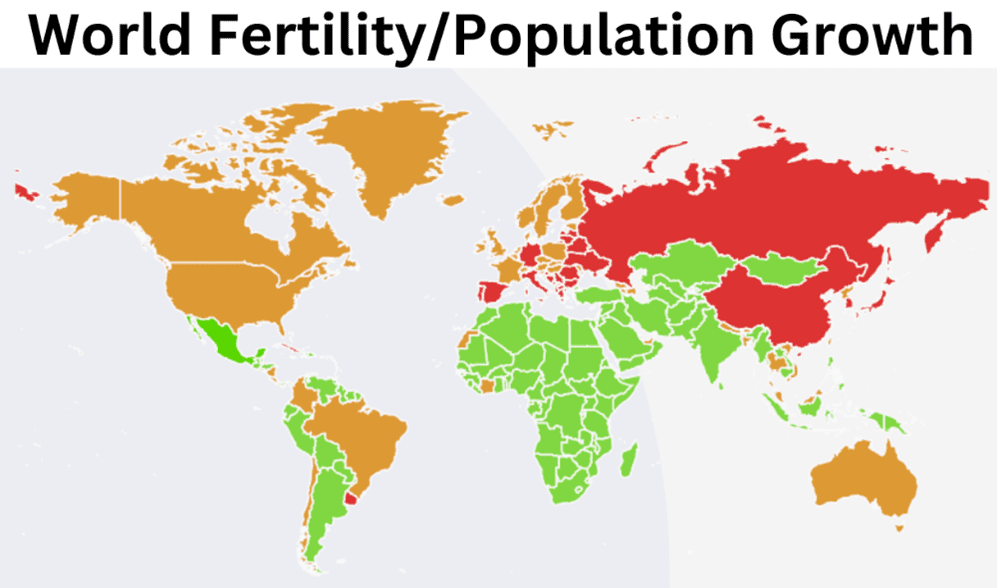
Our world is facing a looming population crisis, but it is not what many people believe. We are not facing a crisis of overpopulation, but rather underpopulation.
The global fertility rate has dropped to its lowest point in six decades. In the 1960s, women commonly had four or five children. As of 2023 the average global fertility rate has fallen to roughly 2.2 children per woman. That means the global population is hovering just above the needed 2.1 replacement fertility rate. However, that number can be deceiving. The entire Western world has fallen behind replacement fertility. Much of what keeps the global average near 2.2 comes from higher birth rates in parts of Africa and the Middle East.
If this trend is not corrected, nations will face fewer workers, rising dependency ratios, shrinking tax bases, and mounting pressure on pension and health systems. These programs are designed only to be solvent within a healthy population pyramid. The base of the pyramid should be a large pool of young people and the top of the pyramid should be seniors. If replacement fertility is not met, populations begin to age, and the pyramid begins to reverse. Fewer children means fewer future innovators, laborers, caregivers, and citizens sustaining our institutions.
Examples across the West are well documented. The United States records fertility well under replacement. Major European nations including the United Kingdom, Germany, Italy, and Spain report rates significantly below 2.1. Japan and South Korea face some of the world’s lowest rates and are already struggling with a shrinking workforce and the social costs of an aging society.
We have documented this concerning population crisis on our website in the form of an interactive population map. The fertility rate and net population growth rate are both shown for every country in the world which reports data. Additionally, we have included examples of what steps each country has taken in an effort to combat declining fertility rates.
Alarmingly, many of the nations which are facing the lowest fertility rates are the very same nations which are aborting their babies. Abortion advocates have often propagated the lie that abortion is a necessary means to prevent global destruction due to overpopulation. While the data now proves that we are not facing such a crisis, but in fact the exact opposite, let’s address the underlying moral claim being made. To attempt to justify abortion in this way is to say that it is morally acceptable to kill innocent children for the perceived greater good.
If this utilitarian view is to be subscribed to, why would it stop with unborn babies? If we are to open the door to violently killing some people for the good of the majority, why then would we not kill homeless people? This is not to give the abortion industry any ideas, but to highlight the moral bankruptcy of their argument. Violating the right to life of innocent children is not a solution to any problem our world may face.
There are many approaches that nations have taken in response to this crisis. Examples include reward programs, childcare subsidies, and paid parental leave. While every nation has the right to try what it believes will yield the best results, there is one obvious first step. Around one million babies are killed in abortion every year in the United States. If we want to raise our fertility rate, we should stop killing millions of babies in the womb. Since 1973, there have been more than 63 million babies aborted in the United States.
If countries around the world do not reverse course and raise fertility rates, there will be devastating consequences. Underpopulation is a looming international crisis that cannot be ignored. The worst thing that we can do is allow the next generation of young people to be killed in the womb. If we want our world to have a bright future, babies are our greatest resource.
Leave a Reply